THE BOOK THIEF
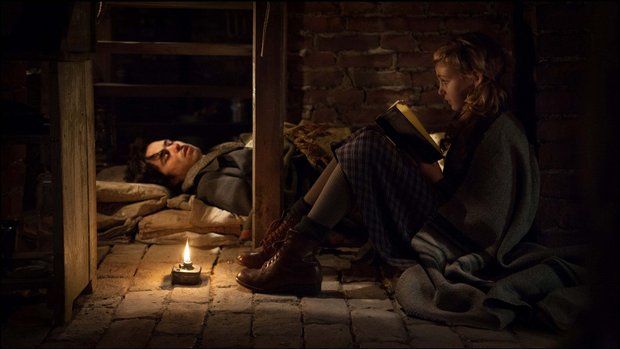
Cast: Sophie Nélisse, Geoffrey Rush, Emily Watson
Director: Brian Percival
131 mins
"Life Is Beautiful" may or may not have set a benchmark for tackiness in Holocaust cinema, but "The Book Thief" offers a hypothetical way in which the former might have been worse, for at least it wasn’t narrated by Death (courtesy of the mellifluous stuffy tones of Roger Allam). Over footage of clouds, the opening voice-over warns viewers of “one small fact - you are going to die.” Thanks Rog. My immediate reaction was – ‘Is this a remake of American Beauty or a rip-off of Brazil (at least visually)'? Thankfully not - The Book Thief is a drama set in late-1930s Germany, adapted from Markus Zusak’s bestselling 2005 novel. Surely however, the conceit of telling the story from the Grim Reaper’s point of view is the kind of device that probably worked better on the page than here on the screen.However I’m glad to
report that this noxious gambit is the worst part of the film, which is
otherwise a smoothly directed story of a child trying to comprehend the
unfathomable. Liesel
(Sophie Nélisse) is entrusted by her Communist-sympathising mother to a pair of
German foster parents, Hans (Geoffrey Rush) and Rosa (Emily Watson), who soon
take in another visitor: Max (Ben Schnetzer), a Jew whose father saved Hans’
life during World War I. Initially illiterate, Liesel enjoys hearing new words,
and is confounded by the book burnings that take place in the centre of town.
She soon learns more complex lessons, as she starts to understand why her
guardians are hiding Max in the basement, and why she can’t reveal this secret
to anyone— not even her best friend Rudy (Nico Liersch), who has roused the ire
of local Nazi party members for idolising and naively blacking up as athlete
Jesse Owens.
Directed
by Brian Percival (whose CV includes helming several Downton Abbey episodes), The
Book Thief falls into many of the traps that set off theorists’ alarm bells:
sentimentalising horror, focussing on survivors rather than victims, softening
the trauma of the Holocaust by looking at it through the eyes of an innocent.
However as melodrama, the film is an absorbing portrait of a community’s
indifference to its own.
Certainly, there are less crude ways to convey the impact of Nazism against Jewish people than to have Liesel ask Hans why he’s scraping a Jewish name off a shop sign. But the story, arguably aimed at younger viewers, is essentially one of recognising insensitivity as Liesel begins to comprehend the adults’ failure to help their Jewish neighbours and to witness the way totalitarianism rules by paranoia, blind obedience, and fearful silence.
In a script arbitrarily and somewhat bizarrely sprinkled with the German word ‘nein' (for 'no'), the French-Canadian Nélisse holds her own amid a more seasoned cast and her scenes with the kindly Rush are particularly delightful and indeed the entire piece offers uniformly excellent work by a splendid cast. The epilogue, though seems a bizarre mis-match for everything that preceded it.
Certainly, there are less crude ways to convey the impact of Nazism against Jewish people than to have Liesel ask Hans why he’s scraping a Jewish name off a shop sign. But the story, arguably aimed at younger viewers, is essentially one of recognising insensitivity as Liesel begins to comprehend the adults’ failure to help their Jewish neighbours and to witness the way totalitarianism rules by paranoia, blind obedience, and fearful silence.
In a script arbitrarily and somewhat bizarrely sprinkled with the German word ‘nein' (for 'no'), the French-Canadian Nélisse holds her own amid a more seasoned cast and her scenes with the kindly Rush are particularly delightful and indeed the entire piece offers uniformly excellent work by a splendid cast. The epilogue, though seems a bizarre mis-match for everything that preceded it.
FILMS FROM THE PAST
HER
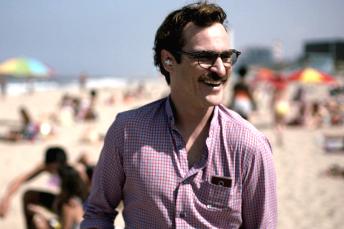
Cast: Joaquin Phoenix, Amy Adams, Olivia Wilde, Scarlett Johansson, Rooney Mara, Chris Pratt
Writer/Director: Spike Jonze
125 mins
Spike Jonze's previous films "Being John Malkovich," "Adaptation" and "Where the Wild Things Are” all showed his unerring ability to take odd, almost un-cinematic material and turn it into features that dazzled, amused and rendered emotional responses in unexpected ways. Now he presents "Her" – the concept of which I was moderately aware of before seeing the film – and I’d expected this might be one subject too far for him. However, all such notions were quickly dispensed as this is an unmitigated joy – and an audacious step into what may not be too distant a technological future. “Her” is, to all intents and purposes, a romantic comedy-drama - but quite unlike any other you may have seen before - and is immensely moving and touching. I'd rather not over-spoil its central thread as it is probably best appreciated by knowing as little about the set-up as possible before settling down for the ensuing two hours.However, if you'd like to read on and won’t mind a slightly more detailed analysis – the film is set slightly ahead in time with Joaquin Phoenix playing Theodore Twombly, a pleasantly bland individual caught in that difficult netherland of post-relationship break-up (in his case a marriage). Theodore’s job entails composing heartfelt letters and notes to people - on behalf of those who are unable to summon up the requisite emotions by themselves. He is quite a proficient success at this and has a platonic chum Amy (Amy Adams), an earnest writer whose latest project covers sleep patterns. Theodore does try, but sadly seems inadequate at successfully dealing in social terms with other people – cue a disastrous conclusion to a date with a beautiful woman.
However his mundane love life takes a quite unexpected turn when he installs OS1, a fabulous new operating system which claims to be the first to feature genuine artificial intelligence. Opening this up on his computer, Theo upgrades from the generic factory settings to a more personalised version and accesses a female voice which goes by the name of Samantha (spoken by Scarlett Johansson). Samantha rapidly gets to work on sorting out Theo's life in all the usual ways - deleting outdated files, copy-editing his work and even helping him to negotiate an exceptionally tricky video game (a genuinely funny scene). However and almost inevitably, she wants to learn more about the world that Theo inhabits in order to satisfy her ever- expanding curiosity. Theo obliges, and in so doing he finds himself reviewing his existence thanks to her cheerful warmth and intelligence. In the process he finds himself gradually gaining in self-confidence until such times as the almost inevitable occurs – they fall in love.
Jonze ingeniously takes this seemingly jokey and futuristic premise and uses it thoughtfully to explore a number of concepts that anyone watching the film will relate to - ranging from mankind's increasingly co-dependent attitude towards advances in technology to the ways in which personal interactions have ironically grown increasingly impersonal thanks to those same developments. Consider the growing culture of computer-generated online dating and the virtual non-commitment fantasies as well as the more sinister deeply emotional connections created between people via that method - to the struggles in every relationship between two people trying to get to know each other and you'll see and feel the significance. More importantly, Jonze's screenplay also manages to brilliantly and effortlessly convey, in ways that are best left for you to discover, the nuts and bolts of what occurs when two people come together from those exciting dizzy beginnings filled with infinite possibilities to the darker moments when one can do nothing but end up alone, feeling dumbfounded, confused and wondering, endlessly, how something once so wonderfully fulfilling, loving, deep and special could now inspire such intense emotional agony.
Following Theo and Samantha as their relationship blossoms from the expected forms of interfacing into something more, the process is superbly achieved in that they take a seemingly absurd notion and bring to it a real sense of warmth and humanity. There is even a sexual sequence of sorts and whilst on paper would sound fatuous and ridiculous, the end result is entirely convincing and effective. Within all this, Jonze remains steadfast towards avoiding the possibility that the story does not fly off into a world of idealised fantasy. One scene in which Theo agrees to meet with his ex (Rooney Mara) to finalise the divorce papers and move on with his life is superbly done. Everything is going well until he blurts out that he is seeing a ‘new’ woman now (plus all the details). This results in his soon-to-be-permanently/legally-ex letting him have it with both barrels – and it is alternately heartbreaking and hilarious. Once the initial bloom of the romance between Theo and Samantha becomes jaded and things become troubled, the situation disintegrates, due in no small part to the fact that the more human she becomes, the more he begins to fall into the same old patterns that he has with his more conventional relationships. The way that Jonze handles the material both as writer and director is wonderful. What really holds "Her" together is the astonishing and intriguingly complex work done by both Joaquin Phoenix and Scarlett Johansson.
Phoenix has to deliver a performance that not only requires him to bare his heart and soul but to do it convincingly whilst acting opposite someone who isn't actually there. As for Johansson, not only does she have to do the same, she has to do it using nothing more than her voice. This is a major hurdle which many actors could fall flat with, but these two overcome any such obstacles and give emotionally resonant and believable performances. This is even more impressive in Johansson's case as she actually recorded her part during post-production when Jonze decided that the original performance, recorded by his first choice Samantha Morton wasn’t quite right for the part. "Her” doesn’t take one single false step and the end result is a gentle, touching, thoughtful and amusing film that is just about perfect.
